

Webinar: AI in Radiology – Companion or Colleague?
Event | KIMed Network Impulse Webinar on November 12, 2026
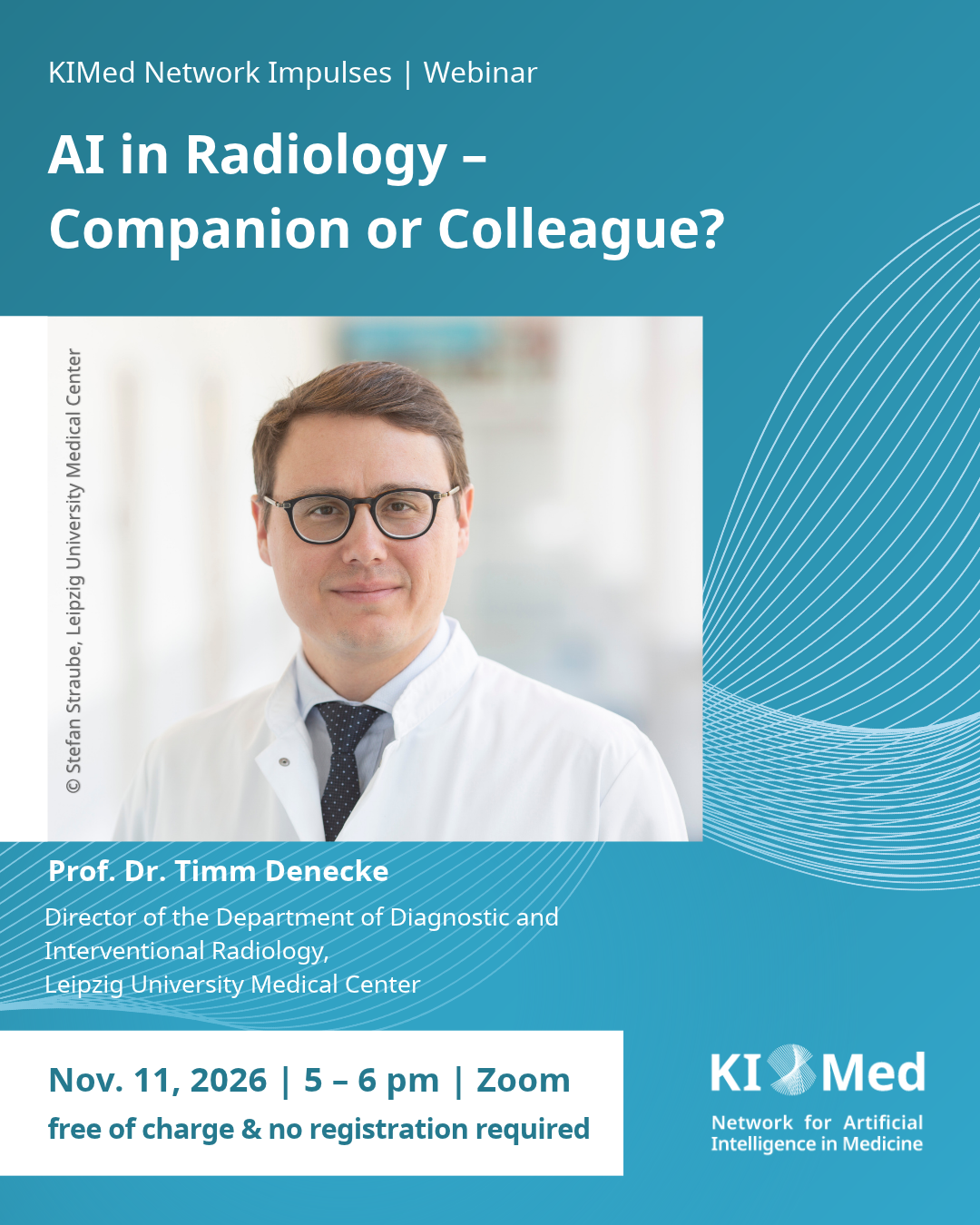
How is artificial intelligence transforming radiology practice? In the next session of the “KIMed Network Impulse” webinar series, Prof. Dr. Timm Denecke, Director of the Department of Diagnostic and Interventional Radiology at Leipzig University Medical Center, will explore the opportunities, risks and potential applications of AI in radiology.
Due to its highly digitalised workflows, radiology offers particularly favourable conditions for the use of artificial intelligence. Machine learning and deep learning methods can already support the development of diagnostic algorithms through the analysis of medical imaging data. Combined with paraclinical data, these methods open up opportunities for large-scale data analysis. AI algorithms are also being used to optimise image reconstruction. In addition, Large Language Models (LLMs) can support the generation of radiology reports.
But which of these potentials can actually be translated into clinical practice? Beyond the technological possibilities, questions also arise regarding the risks and implications for patients and radiologists alike.
Following a short introductory presentation, we will discuss with Prof. Dr. Timm Denecke which factors determine the acceptance and use of AI tools in everyday clinical practice and what future prospects may emerge from integrating AI into radiology.
At a glance
Title: AI in Radiology – Companion or Colleague?
Speaker: Prof. Dr. Timm Denecke, Director of the Department of Diagnostic and Interventional Radiology at Leipzig University Hospital
Date: 12 November 2026 | 5–6 pm (CET)
Language: German
Access: Free of charge & no registration required | Zoom link: https://uni-leipzig.zoom-x.de/j/5338264710?omn=68778800030